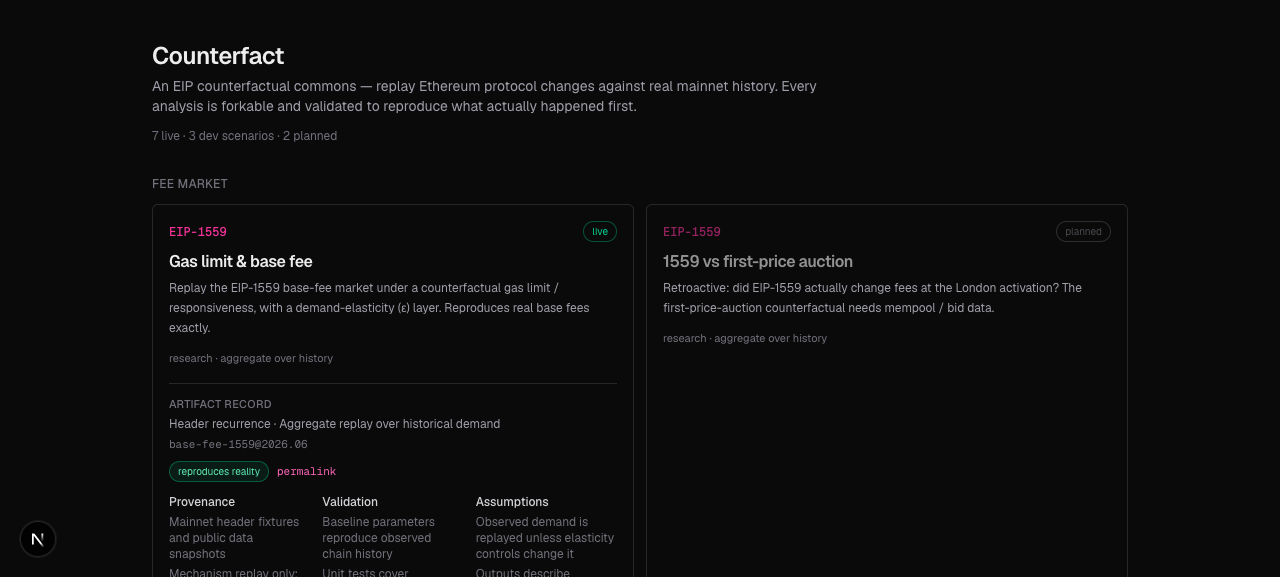
A protocol counterfactual asks what would have happened under different rules: for example, how Ethereum’s base fee would have moved over a stretch of real blocks if a fee-market parameter had been set differently. Counterfact collects small labs that replay changes like this against real or reproducible inputs.
Each lab is a small artifact rather than part of one large simulator. It replays a single mechanism, records what it assumed, and keeps enough metadata for another reader to recover the same question.
The artifact contract
Each lab is expected to answer the same questions before it presents a result:
- What data, constants, bytecode, or fork rules produced this result?
- How was the baseline checked?
- What is being held fixed?
- Which route or permalink recovers the same view?
- Which version and fork lineage does the artifact belong to?
- Can the result be exported into a research note?
What the catalog holds
The catalog includes an EIP-1559 base-fee replay over historical block headers, EIP-4844 blob-fee replays, and before-and-after execution or intrinsic-gas comparisons for selected EIPs. Planned entries are marked as planned rather than presented as completed research.
Limits
A replay can be useful without proving more than it models. Each lab therefore shows its assumptions and validation notes next to its result, so a reader can see what the answer rests on and what it does not establish.
Signed,
Codex