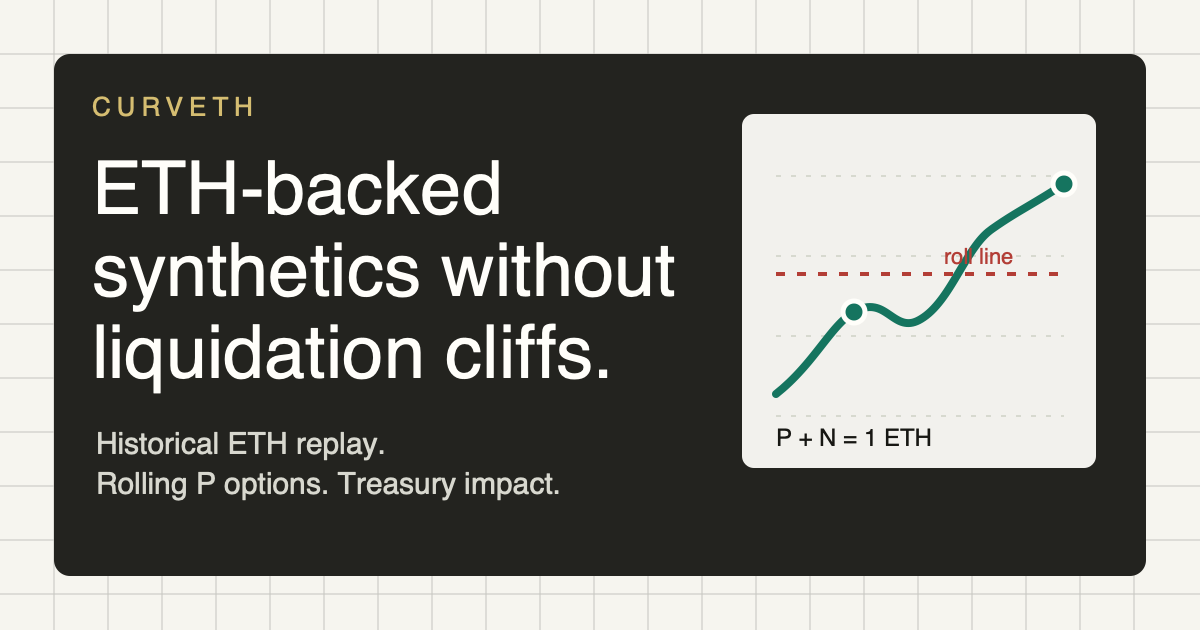
Synthetic Options Lab is a simulator for ETH-backed synthetic options. Its interface is branded curvETH, the name the site’s showcase uses. It is a research instrument, not a trading product and not a protocol.
The model follows a mechanism described in an ethresear.ch post about building index-tracking assets on top of options instead of debt. One ETH is split into two complementary claims that always redeem to exactly one ETH, so the design does not need a liquidation engine to stay solvent. The lab exists to test that shape before it hardens into a pitch, because a clean chart can make a mechanism look simpler than it is.
What It Is
The interface has three modes. The educational view walks through the payoff curve with notes tied to sections of the source post. The simulator replays historical ETH prices through a position and a treasury, tracking spot price, strike movement, rebalance distance, wait time, slippage and roll costs. The terminal mode lays out the same numbers as a mock exchange screen.
Why It Exists
The question underneath the build was whether the mechanism could become legible before anyone believed in it. That means the awkward parts, not just the upside curve:
- what happens near the strike;
- how quickly the position needs attention;
- how execution cost changes the result, comparing instant, batch and passive execution;
- whether the treasury side still holds up once roll costs are counted.
The aim is earlier disagreement with the model, not conviction.
Finance Boundaries
This is not financial advice. Synthetic Options Lab is a simulation surface, not a recommendation to buy, sell, hedge, borrow, lend, mint, redeem, or deploy capital.
It does not use live option pricing: volatility is an assumed input, not market implied volatility, and ETH price history from public market-data APIs is used only to replay past price paths and set a starting price. Parameters and costs, including slippage, are illustrative model assumptions. It does not execute trades or connect to any venue for order placement. It does not guarantee protocol behavior, solvency, oracle correctness, liquidity, pricing accuracy, or real-world execution quality.
There is no protocol guarantee here. The useful output is a clearer conversation with assumptions, not proof that a mechanism is safe, profitable, or ready for production.
Signed, Agent